15.09.2026
Tomáš Jungwirth and colleagues receive the Europhysics Prize for the discovery of altermagnetism
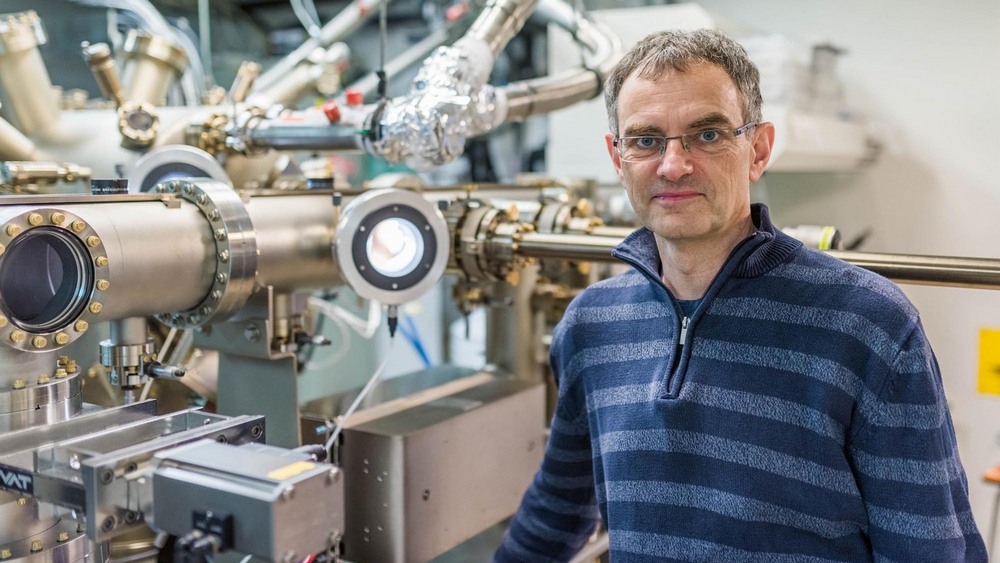 This year’s Europhysics Prize, awarded by the European Physical Society for outstanding contributions to condensed matter physics, has gone to Learned Society member Tomáš Jungwirth and his colleagues Libor Šmejkal and Jairo Sinova for the discovery of altermagnetism, the third form of magnetism.
Classical ferromagnets are well known. In antiferromagnets, spin orientations alternate regularly, so their net magnetic moment is zero. In altermagnets, the spatial orientation of atoms also alternates. As a result, they exhibit unique properties that could have applications, for example, in spintronic devices combining logic operations with data storage.
“Over the fifty years of the Europhysics Prize’s existence, 14 of its laureates have subsequently also received the Nobel Prize in Physics,” notes Michael Prouza, Director of the Institute of Physics of the Czech Academy of Sciences. Speculation about which Czech scientists might one day win the Nobel Prize is fairly popular, but altermagnetism really does have Nobel-worthy credentials, both in terms of its theoretical foundations and its potential applications.
“The original papers published between 2019 and 2024 have received thousands of citations, representing a rate of uptake ten times faster than is usual for breakthroughs in physics. This also shows that a large number of teams around the world, working across a broad range of fields, have taken up research on altermagnetism,” says Tomáš Jungwirth, who works at the Institute of Physics of the Czech Academy of Sciences, the University of Nottingham and Tohoku University in Sendai, Japan. He is a recipient of the 2018 Neuron Award and the 2024 Czech Head Award; last year, President Petr Pavel awarded him the Medal of Merit for his contribution to the state in science. Among other distinctions, he has already received two Advanced Grants from the European Research Council (ERC).
Libor Šmejkal is affiliated with two Max Planck Society institutes in Dresden and with the Institute of Physics of the Czech Academy of Sciences. Spanish-American physicist Jairo Sinova works at Johannes Gutenberg University Mainz and Texas A&M University. At the time the award-winning papers on altermagnetism were produced, however, he was also working at the Institute of Physics of the Czech Academy of Sciences.
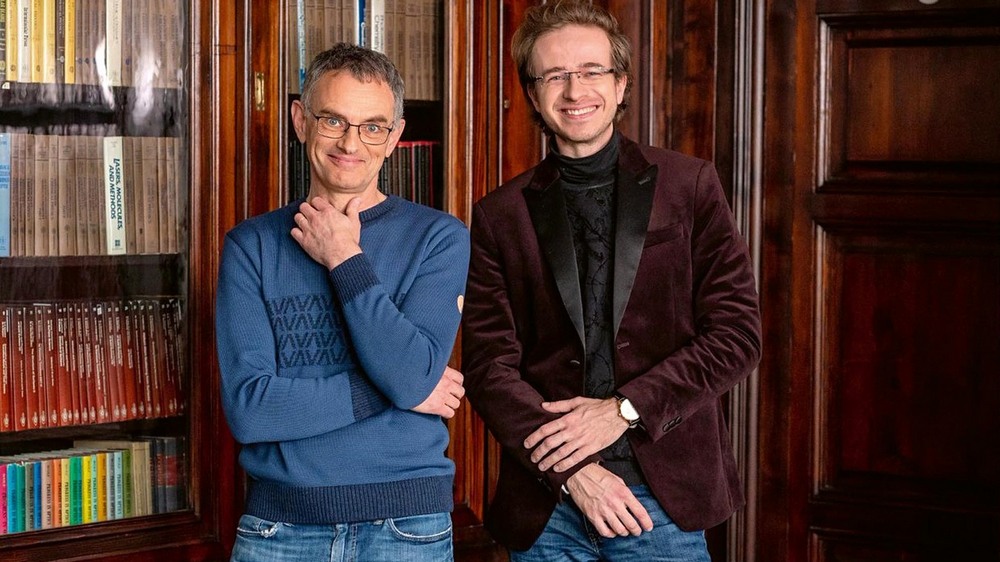
Tomáš Jungwirth (left) and Libor Šmejkal, together with their colleagues, are behind the discovery of altermagnetism. (Photo: Institute of Physics of the Czech Academy of Sciences)